The following is a presentation that I used for all the staff at Hornby Primary (Teacher Aides included), as an introduction to the new learning model that we are beginning to implement.
I discovered the 'Movenote App', which I intend to use in my classroom, so I thought it would be a good opportunity to practise using it, to understand its functions.
I have attached both the Movenote presentation and the slideshow presentation.
Showing posts with label UDL. Show all posts
Showing posts with label UDL. Show all posts
Wednesday, 19 August 2015

Friday, 14 August 2015
Universal Design for Learning.
UDL (Universal design for learning) What is it and how can we use this in our classroom?
Learn, Create, Share. What is it and how can we use this in our classroom?
Can these be married together?
Do they need to be married, or can they sit nicely beside each other?
Before we look at these in more depth, we need to answer the WHY?
To raise student achievement. Motivate and engage all learners in our classrooms especially students who are disengaged in education, have learning disabilities and have high learning needs.
If we get it right for these children, we get it right for all children.
As educators we need to ask ourselves this one question. How can we remove barriers and provide support that will enable all children to learn?
UDL is made up of three principals as shown on the diagram below.
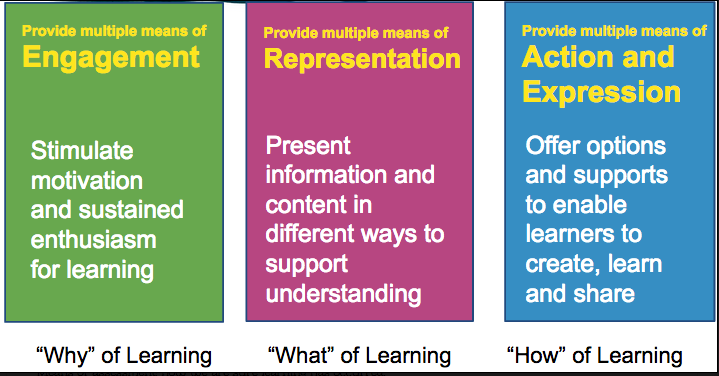
When looking at the curriculum (learning) UDL has 4 main components, each that needs to be universal.
- What are the goals (of the learning)? How do we translate standards (learning intentions) into things that are important to do in the classroom.
- What are the materials? (books, websites, videos, posters, pictures wall displays) Are they key to learning, if so are they universal?
- Methods. How does the teacher deliver the curriculum? Lecture, collaborative groups, experiences, practical activities.
- Means of assessment. How are we sure learning has occurred?
So what might this look like in your classroom?
Maths
Principal 1 - Engagement
Why do you need to learn your basic facts?
It’s important because we use maths everyday. Shopping, measuring, driving a car, cooking. Many jobs require you to use maths, e.g. trades, truck driver, accountants, retail, teaching and even doctors.
Principal 2 - Representation
Giving children opportunities to learn in different ways.
Instructional lessons, videos (teacher tools), using materials, digital tools, flashcards, singing table songs, rote learning.
Principal 3 - Action and Expression
What the children do to show their understanding, using equipment (counters, rods, abacus etc), number lines, tests, Explain Everything on Ipad or making a video explaining the strategy that they used.
So where does Learn, Create, Share fit?
I see that it plays an important part of the Representation stage and an even more significant role in the Action and Expression stage.
What does this mean for the learning in my class?
Creating learning activities with less barrier (no barriers in a perfect world). Allowing agency for children to express their understanding. It’s ok if someone wants to use Puppet Pals, while others use slide show and someone else draws a picture.
This is not rocket science, this is quality teaching and learning for all those in our classrooms.
I want to acknowledge Mark Maddren from Core Ed, for his presentation on UDL.
Subscribe to:
Posts (Atom)