Translate

Showing posts with label RTC8. Show all posts

Wednesday, 21 June 2017

What is Success and Why?

2016 was a really big year for the Senior School at Hornby Primary School. Lots of new learning for teachers and students and more importantly, students and teachers getting out of their comfort zones.

So what is the 1:1 digital classrooms and the learning model of  Learn, Create share doing for our learners?   The answer, 'Bucket loads' and the best thing is that we have the data to show this!

The data from our E-asttle results shows us that we have accelerated learning and our Year 5 and 6 students are now achieving above the national norms.   Our Year 4's have also made significant gains.

But what was more pleasing and satisfying for me, was our 'Me and my School survey results that all of our year 4, 5 and 6 students completed.   The results were outstanding especially in our year 6 group.

Year 6 (n=38)
Scored higher on 27 of the 28 questions than NZ norms

The one question was 1% point lower than NZ norm

Significant responses - agree/strongly agree

  • I have a lot of respect for my teachers: 100%
  • My teachers help me learn: 100%
  • Doing well at school is very important to me: 98%
  • At school I always try to do my best: 98%
  • I feel like I am making progress at school: 95%
  • When I’m learning something that’s hard I keep on trying until I get it: 94%
  • I feel my culture is valued and respected at my school: 92%

So what's happening at our school that is causing children to accelerate their learning and also be extremely happy to attend school.    I took my time to reflect on this and have come to a couple of conclusions.  Our children are hooked.   The digital platform that we have created  caters for all students.  They are engaged but more importantly teachers are activating learning.

As teachers we are spending more time teacher and less time managing the class.  The learning is authentic and has a purpose.  The students see themselves as teachers and learners and the have a voice with a world wide audience.  This directly relates to Learn, Create, Share and the affordances of digital technologies.

So what does learning look like?  why are we making significant shift?

I created this presentation after discussions with the other teachers in the senior school team, which is essentially a reflection of our writing practice.


We had a really good reflection session at our last staff meeting run by Kate Mclachlan our literacy leader.  What got me really excited was that although we have had significant success, everyone of our staff was reflecting on what they could do to improve their practice.  We all had a clear idea of what our next steps were.

That in my books is a recipe for success.  Not being happy with status quo,  but striving to better ones practice collectively.  A great example of teacher as inquiry.


Thursday, 7 July 2016

Visible Teaching and Learning

This is my third year Team Teaching (Collaborative Teaching) with my colleague Kate.  We have made many changes over this time to make this work for us, but more importantly for it to work for the children. One of the philosophies that we have held dearly to during this time, is that all teaching and learning is visible.

Why is this important to us?  Firstly we wanted children to have a clear understanding of what they are learning, why they are learning it and their next learning step will be.  Secondly we wanted learning and teaching to not only be visible to the students, but also the parents and whānau.   Essential visible teaching and learning strengthen the home and school connections.

Understandably our understanding and implementation of visible teaching and learning has changed significantly during this process.  The most significant changes that have occurred are due to the integration of devices into learning programme, which gave us better opportunities and a platform to create an environment that promotes visible teaching and learning.

Initially we had limited resources, 6 Ipads (2014).  We then introduced 10 chrome books into our classroom as a pilot to gain a better understanding of working in a digital environment.  In 2015 we we fortunate enough to have enough Chrome books for 1:2.  This gave us more opportunities but we were still limited, as we had one foot in the digital classroom and the other foot in the analogue classroom, which creates twice the work.  Thankfully this year we are 1:1 (chrome books) over half of them student owned.

The most important  part of this process hasn't been the technology, it has been the pedagogy  that now drives our teaching and learning, which is Learn, Create, Share.  We are on our second year of the Manaiakalani Outreach Programme.  Learn, Create, Share is visible teaching and learning. With our assistance and guidance from our Manaiakalani outreach facilitator Mark Maddren, we have been able to develop a better understanding of what this looks like and how we can implement it into our programme.

This year we have built a learning site where the children access their learning.  This alone has made teaching and learning more visible.  Children are able to continue their learning at home and have access to the resources that we have used to enhance the learning. We have also used a class blog over the past two years to share with the parents and whānau what the children are learning.  But the problem with the class blog was it wasn't personalised for the individuals in the class.  Parents could see what the class was doing, but not necessary what the individual child was doing or how they were progressing. This term the children all have their own personal blog.  This has opened up a lot of doors for us as their teachers, there whānau and more importantly them.

We have learnt pretty quickly that you can have a class site, and blogs but that doesn't necessarily make your teaching and learning visible. Especially if the parents and whānau don't know about them, or know how to access them.  Initially we were encouraging the children to go home and share both the site and their blogs with the parents with limited success.  Luckily for us we had learning conferences at the end of term 2.  This was the perfect opportunity to not only expose the parents to the learning site and their individual blogs,  but also to showcase how they are used in our programme but more importantly how they can access them.

We are required to report to parents for National Standards twice a year, but we didn't want the children's leaning conference to be just about that.  We wanted it to be a showcase of what they can do and to celebrate their achievements.   We wanted the parents to have a better understanding of Learn, Create, Share, and what visible teaching and learning is.   We wanted to show them how they can access and connect with what their child is doing in the classroom.  We wanted them to leave those learning conferences with the confidence to connect with their child's learning.

Traditionally we get around  70%-80% of parents turn out to learning conferences if we are lucky, which isn't ideal.  Traditionally Kate and I do the heavy lifting for the children in preparation for these, and a significant amount of the heavy lifting during the conferences.  Traditionally after Learning conferences we feel completely washed out as most teachers can relate to.

Things were significantly different this year.

All of the children created a slideshow, which consisted of 5 slides.  The first 3 slides covered there learning goals for reading, writing and maths.  Children had to find evidence to show whether or not they had achieved their goals or still need to work on them.  The children were able to link blog posts and blog comments they had written as evidence, they were able to link their digital modelling book, and anything else in their drive that could be used as evidence.

The forth slide was a mid year reflection where they had to describe what has helped their learning and also what they are most proud of.

The final slide was an opportunity for the children to teach the parents how to write  blog comments using the formate the children use (positive, thoughtful and helpful).  We gave the children plenty of time to create their presentation and practice presenting it, ensuring that they highlighted their evidence they collected and explain their next learning steps. We felt comfortable allocating as it was easily justified as it essentially covered our schools key characteristics.

Learning goal template


The end result was great.  We had children excited about learning conferences, nagging parents to make sure that they turned up.   We had the best turn out we have ever had 52/54 of the children's family and whānau turned up and we are confident of catching up with the final 2 families. Both of those children have shared their presentation with their families.

As for heavy lifting and feeling feeling wiped out after two days of learning conferences.  Not at all! For the first time our student led conferences were in fact student led. Students were able to justify why they have achieved goals or why they were still working on them.  More importantly the parents and whānau left the conferences knowing how to access the site and their child's blog.  They also had a better understanding of what visible teaching and learning is.


Is it perfect?  Far from it and we have a clear understanding of what our next steps are, such as creating a parent portal on our site.  There are a few families who do not have internet access, so we need to adapt to cater to them.

We can definitely be more visible with teaching and learning, but we have come a long way since our journey began in 2014.  Having had individual blogs for children since the beginning of term 2 has made a huge difference.

Has this created more work for us?
I personally don't think so, we aren't working harder, we are working smarter.  The initial set up  of the blogs was a lot of work but now the children are doing all the heavy lifting.


Resources that we are using to promote visible teaching and learning:

  • Google apps (Docs, slides sheets etc)
  • Classroom site
  • Class blog
  • Individual blogs
  • Screencastify
Other things that we use to also promote visible teaching and learning:
  • Sight, sound and motion
  • Rewindable learning
  • Children creating digital learning object
Presentations for parents about what learning looks like in Ako Ngātahi.


Examples of children's presentations.


Wednesday, 27 January 2016

SOLO Taxonomy

SOLO Taxonomy

The Structure of Observed Learning Outcomes

Presented by Pam Hook

Resource Links

Solo Taxonomy Resource

Solo Maps

Solo Rubrics


SOLO Taxonomy
Why:  To accelerate student achievement.
What:  A simple learning model that can be used and adapted to all learning.  Research based with clear evidence that it works.

You need effort to learn,  the first effort is coming up with your ideas no matter how simple it may seem, then to connect your ideas, then finally extending your ideas.  Essentially this model create life long learners.

'Bring in' activities -  Bringing in ideas about a topic .  Whats your next step?  I need to 'connect my ideas'.

There are 3 types of negative label that learners often put on themselves that could be found in our classes:

Fixed ability 'Smart' - These children are essentially damaged because they have been told that they are smart and have often found school easy and boring.  But when challenged they do not show resilience and do not take risk, risk adverse.  Use excuses like I'm bored,  too easy ,  I'm still finishing it.  Rejects opportunities to learn if they might make mistakes.

Lucky -  I got a good mark or result because my teacher likes me or the work I did.

Fixed ability 'Not Smart' - These children have a negative attitude towards learning because they find learning difficult and when challenged by learning they use diversion tactics to avoid being made looking silly in front of friends.  They may make jokes about it to make their friends laugh, or refuse to do it,  have a melt down.  Essentially anything to avoid the learning process because they find it difficult.

SOLO doesn't label the learner it labels the learning.

Praise or feedback given by teachers has a huge effect on all learners in your classroom.  Praise the effort not the result.

Learning is not about being smart, dumb or lucky, its about bringing in ideas, connecting them, then extending those ideas and pushing them out somewhere new.

"The most powerful model for understanding these three levels and integrating them into Learning Intentions  and Success Criteria is the SOLO developed by Biggs and Collis 1982"
Hattie 2012 p54

Sandpit Pedagogy (Brainstorming on steroids.)  SOLO Hexagons
Students put ideas, information  or data onto hexagonal shapes.  They then try to join their hexagons depending on what the information is.
We tried this as a group,  we had to come up with ideas about morning tea.  We were able to link all our ideas.


This was an absolute light bulb moment of how these could be used in all areas, especially reluctant learners.  

Engagement
As teachers if a student is prestructural ( have no ideas about a topic)  then it is your job to engage the students.  But that is the only part of the SOLO model that engagement is important.  What is important is the what the students are learning and the progress they are making.  Children can be engaged but making any progress.

What SOLO looks like for Primary school Children.
Prestructual -
Unistructural - Define
Multistructural - Describe
Relational - Sequence, classify, Compare & contrast, Cause & Effect, Analysis, Analogy
Extended Abstract - Generalisation, Prediction, Evaluate and create

A link to the Learning Intention Generator, that is an amazing tool for planning.  This produces a range of learning intentions for all area of the SOLO taxonomy model, which inevitably caters for all children in your class that would be working at different parts of the model.
SOLO Maps

SOLO Maps helps children unpack the different parts of SOLO Taxonomy.  It gives them the skills to define, analysis and all of the other skills at the different stages of SOLO.  Maps are a great way for students to organise their ideas, it scaffolds the planning process. 

Solo Maps

The Declarative Knowledge Rubric helps children understand where they are on the SOLO model when using the maps.  It gives them a clear pathway to their next step.

Functioning Knowledge - The ability to do it physically.  I can surf.

Declarative Knowledge - is the ability to talk or explain, write about a topic.  I can write about a surfer.

The Functioning Knowledge Rubric creator help children understand where they are when demonstrating something and what they need to do to move forward.


  • Its not just getting children to bring in their ideas but getting them to reflect on these ideas.
  • Don't give the children blank maps, give them clues in the maps such as technical language.
Achieving the learning goal.
  • Prior Knowledge - prior skills, prior competencies, prior attitudes, prior behaviors.
  • Link: ideas - relate - extend
  • Metacognition:  What I am doing? How well is it going? What should I do next?
  • Feedback:  on learning goals, with peers, with teachers
  • Multiple Ways: of knowing about a goal, of interacting with a goal, opportunities to practise.


Friday, 23 October 2015

Manaiakalani Outreach Programme Toolkit Presentation


This week Kate and I presented at the MOP toolkits.  We shared this presentation which gave an insight into the Learn Create Share journey and the integration of Chrome books into our delivery of the curriculum.

For some of our audience this wasn't anything new, but for others it gave them some practical ideas they could take and adapt into their own programmes.

On a personal level I found this a good reflective activity of how far we have come this year.  Using the chrome books in our programme on a day to day basis has become second nature.  The children's ability to use the devices has also improved significantly and they now expect to use them.

I am definitely looking forward to being in a 1:1 classroom next year and be in a fully digital environment.

Friday, 14 August 2015

Universal Design for Learning.

UDL (Universal design for learning) What is it and how can we use this in our classroom?
Learn, Create, Share.  What is it and how can we use this in our classroom?


Can these be married together?
Do they need to be married, or can they sit nicely beside each other?


Before we look at these in more depth, we need to answer the WHY?


To raise student achievement.  Motivate and engage all learners in our classrooms especially students who are disengaged in education, have learning disabilities and have high learning needs.  
If we get it right for these children, we get it right for all children.


As educators we need to ask ourselves this one question.  How can we remove barriers and provide support that will enable all children to learn?


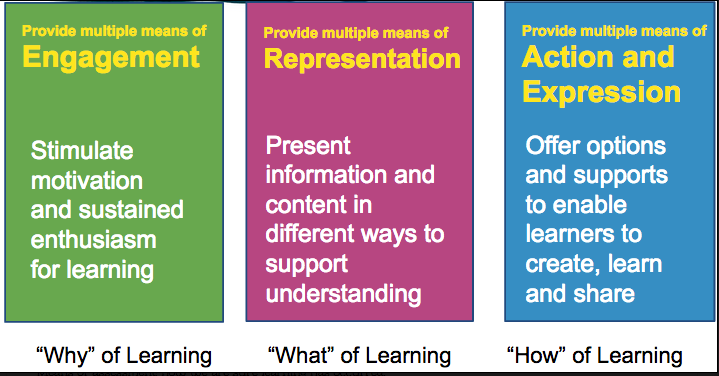
UDL is made up of three principals as shown on the diagram below.

Screen Shot 2015-08-07 at 9.20.31 AM.png


When looking at the curriculum (learning) UDL has 4 main components, each that needs to be universal.


  1. What are the goals (of the learning)?  How do we translate standards (learning intentions) into things that are important to do in the classroom.
  2. What are the materials? (books, websites, videos, posters, pictures wall displays)  Are they key to learning, if so are they universal?
  3. Methods.  How does the teacher deliver the curriculum? Lecture, collaborative groups, experiences, practical activities.
  4. Means of assessment.  How are we sure learning has occurred?


So what might this look like in your classroom?


Maths
Principal 1 - Engagement
Why do you need to learn your basic facts?
It’s important because we use maths everyday.  Shopping, measuring, driving a car, cooking.  Many jobs require you to use maths, e.g. trades, truck driver, accountants, retail, teaching and even doctors.


Principal 2 - Representation
Giving children opportunities to learn in different ways.
Instructional lessons, videos (teacher tools), using materials, digital tools, flashcards, singing table songs, rote learning.


Principal 3 - Action and Expression
What the children do to show their understanding, using equipment (counters, rods, abacus etc), number lines, tests, Explain Everything on Ipad or making a video explaining the strategy that they used.


So where does Learn, Create, Share fit?


I see that it plays an important part of the Representation stage and an even more significant role in the Action and Expression stage.


What does this mean for the learning in my class?


Creating learning activities with less barrier (no barriers in a perfect world).  Allowing agency for children to express their understanding.  It’s ok if someone wants to use Puppet Pals, while others use slide show and someone else draws a picture.


This is not rocket science, this is quality teaching and learning for all those in our classrooms.

I want to acknowledge Mark Maddren from Core Ed, for his presentation on UDL.