Translate

Showing posts with label Share. Show all posts

Tuesday, 14 June 2016

Blogging! Has it made a difference?


I have been on this journey for a while now and it's time to reflect on the changes that have occurred, or difference that it has made in my delivery of the curriculum and more importantly  student success.

This term my class all started blogging on their individual blogs.   The children were very familiar with the blogs as we had a class blog that we used successfully last year and the beginning of this year to promote visible teaching and learning.

The impact on engagement was instant.  Children are highly motivated to 'share' or post on their blogs. They have an authentic global audience.   There is more purpose to what they are working on and are connecting with friends and family across New Zealand and in some cases overseas.

The most important part of this process has been teaching the children how to comment on other children posts.  They follow the 3 steps of write something positive, thoughtful and helpful.


By following this template it has stopped children from giving shallow feedback like 'Good work',  'Awesome, well done!'.  Their comments now are full of advice or questions that promote further learning or initiate a learning conversation.  But the biggest impact to the students learning has been the improvement of punctuation in their writing.  This has been transformational!  Through the combination of the  3 steps to writing a comment and having an authentic audience the children's punctuation has improved out of sight. 

Here are some examples.


This had made me make changes to my delivery of writing.  I have stopped giving children constrained practice activities (worksheets), related to surfaces features like punctuation.  These have been replaced with blog commenting.  Not only is this a more authentic writing activity and engaging, it has lightened my workload in terms of finding or creating the activity and then making them all.

Finally, my ultimate aim as an educator is to cause learning.  My biggest change that I am currently working through is ensuring that all teaching and learning is visible.  Why?  Because not only do I want to engage the students, but I also want to engage the Parents, Caregiver and Whānau, so they can play an important part of the learners journey.  

So is this happening?


This is gold!  How does a comment like this make a student feel?  That's easy to answer.  It motivates and drives them, it gives them a huge sense of pride, they see themselves as a learner, an author and a teacher.  They have a voice and a world wide audience that is listening!

I would like to acknowledge Mark Maddren for his ongoing support as the Manaiakalani Outreach facilitator.

Friday, 14 August 2015

Universal Design for Learning.

UDL (Universal design for learning) What is it and how can we use this in our classroom?
Learn, Create, Share.  What is it and how can we use this in our classroom?


Can these be married together?
Do they need to be married, or can they sit nicely beside each other?


Before we look at these in more depth, we need to answer the WHY?


To raise student achievement.  Motivate and engage all learners in our classrooms especially students who are disengaged in education, have learning disabilities and have high learning needs.  
If we get it right for these children, we get it right for all children.


As educators we need to ask ourselves this one question.  How can we remove barriers and provide support that will enable all children to learn?


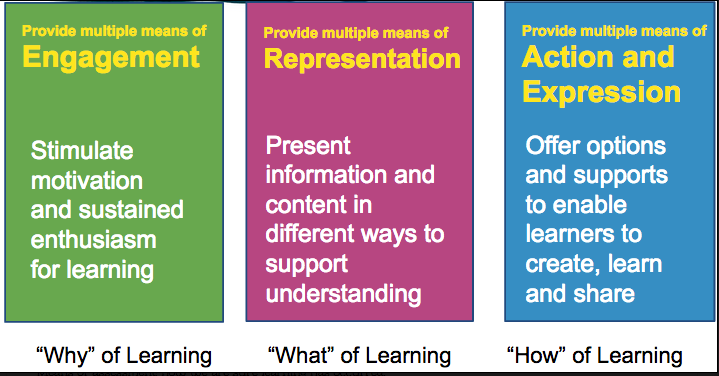
UDL is made up of three principals as shown on the diagram below.

Screen Shot 2015-08-07 at 9.20.31 AM.png


When looking at the curriculum (learning) UDL has 4 main components, each that needs to be universal.


  1. What are the goals (of the learning)?  How do we translate standards (learning intentions) into things that are important to do in the classroom.
  2. What are the materials? (books, websites, videos, posters, pictures wall displays)  Are they key to learning, if so are they universal?
  3. Methods.  How does the teacher deliver the curriculum? Lecture, collaborative groups, experiences, practical activities.
  4. Means of assessment.  How are we sure learning has occurred?


So what might this look like in your classroom?


Maths
Principal 1 - Engagement
Why do you need to learn your basic facts?
It’s important because we use maths everyday.  Shopping, measuring, driving a car, cooking.  Many jobs require you to use maths, e.g. trades, truck driver, accountants, retail, teaching and even doctors.


Principal 2 - Representation
Giving children opportunities to learn in different ways.
Instructional lessons, videos (teacher tools), using materials, digital tools, flashcards, singing table songs, rote learning.


Principal 3 - Action and Expression
What the children do to show their understanding, using equipment (counters, rods, abacus etc), number lines, tests, Explain Everything on Ipad or making a video explaining the strategy that they used.


So where does Learn, Create, Share fit?


I see that it plays an important part of the Representation stage and an even more significant role in the Action and Expression stage.


What does this mean for the learning in my class?


Creating learning activities with less barrier (no barriers in a perfect world).  Allowing agency for children to express their understanding.  It’s ok if someone wants to use Puppet Pals, while others use slide show and someone else draws a picture.


This is not rocket science, this is quality teaching and learning for all those in our classrooms.

I want to acknowledge Mark Maddren from Core Ed, for his presentation on UDL.