Translate

Showing posts with label Learning. Show all posts

Tuesday, 1 March 2016

2016 Inquiry

Can reporting digitally to parents over 4 terms be more effective at informing parents/caregivers about the child’s progress/ performance at school than the traditional written reports?
The following inquiry will be run by Kate Weaver and Simon Scott in 2016:  
We will run a Teacher as Inquiry for the year seeing how effective reporting to the parents digitally will be in terms of the understanding the parents have about their child’s capabilities and how they can assist their children in their learning.  


We will be using the children’s individual blogs to share the children’s learning over the year.  Each term we (teachers) will be adding links to these blogs where they will have access to digital reports in the form of Learning Stories, videos and National Standards reports.


Children will also be taught how to find evidence of their learning and relate it to the Learning progressions.  This will mean the children have a better understanding of what they are able to do and what their next step is.   This will ultimately have a huge impact on student led conferences, as the children will be sharing this evidence with their parents.


We want to talk to as many parents as we can and survey them about how they feel about the traditional written reports and how we could improve them.  Also, what do they want to know about their child's learning and what is their understanding of National Standards in regards to their child’s achievement.


Their will be a survey about parents/caregivers satisfaction and understanding of reporting and the feedback they are receiving from us.  This will be done beginning, middle and end of the year.


We will also continue to develop parental understanding of chromebooks/ Blogs and how to access and interact with their child’s learning, through workshops (Tekkie Breakie) that will be run throughout the year.

This will run nicely with where we are heading with ‘learn, create, share’ and the importance of visible Teaching and Learning for children and caregivers.

Click here to see the parent survey:


Wednesday, 27 January 2016

SOLO Taxonomy

SOLO Taxonomy

The Structure of Observed Learning Outcomes

Presented by Pam Hook

Resource Links

Solo Taxonomy Resource

Solo Maps

Solo Rubrics


SOLO Taxonomy
Why:  To accelerate student achievement.
What:  A simple learning model that can be used and adapted to all learning.  Research based with clear evidence that it works.

You need effort to learn,  the first effort is coming up with your ideas no matter how simple it may seem, then to connect your ideas, then finally extending your ideas.  Essentially this model create life long learners.

'Bring in' activities -  Bringing in ideas about a topic .  Whats your next step?  I need to 'connect my ideas'.

There are 3 types of negative label that learners often put on themselves that could be found in our classes:

Fixed ability 'Smart' - These children are essentially damaged because they have been told that they are smart and have often found school easy and boring.  But when challenged they do not show resilience and do not take risk, risk adverse.  Use excuses like I'm bored,  too easy ,  I'm still finishing it.  Rejects opportunities to learn if they might make mistakes.

Lucky -  I got a good mark or result because my teacher likes me or the work I did.

Fixed ability 'Not Smart' - These children have a negative attitude towards learning because they find learning difficult and when challenged by learning they use diversion tactics to avoid being made looking silly in front of friends.  They may make jokes about it to make their friends laugh, or refuse to do it,  have a melt down.  Essentially anything to avoid the learning process because they find it difficult.

SOLO doesn't label the learner it labels the learning.

Praise or feedback given by teachers has a huge effect on all learners in your classroom.  Praise the effort not the result.

Learning is not about being smart, dumb or lucky, its about bringing in ideas, connecting them, then extending those ideas and pushing them out somewhere new.

"The most powerful model for understanding these three levels and integrating them into Learning Intentions  and Success Criteria is the SOLO developed by Biggs and Collis 1982"
Hattie 2012 p54

Sandpit Pedagogy (Brainstorming on steroids.)  SOLO Hexagons
Students put ideas, information  or data onto hexagonal shapes.  They then try to join their hexagons depending on what the information is.
We tried this as a group,  we had to come up with ideas about morning tea.  We were able to link all our ideas.


This was an absolute light bulb moment of how these could be used in all areas, especially reluctant learners.  

Engagement
As teachers if a student is prestructural ( have no ideas about a topic)  then it is your job to engage the students.  But that is the only part of the SOLO model that engagement is important.  What is important is the what the students are learning and the progress they are making.  Children can be engaged but making any progress.

What SOLO looks like for Primary school Children.
Prestructual -
Unistructural - Define
Multistructural - Describe
Relational - Sequence, classify, Compare & contrast, Cause & Effect, Analysis, Analogy
Extended Abstract - Generalisation, Prediction, Evaluate and create

A link to the Learning Intention Generator, that is an amazing tool for planning.  This produces a range of learning intentions for all area of the SOLO taxonomy model, which inevitably caters for all children in your class that would be working at different parts of the model.
SOLO Maps

SOLO Maps helps children unpack the different parts of SOLO Taxonomy.  It gives them the skills to define, analysis and all of the other skills at the different stages of SOLO.  Maps are a great way for students to organise their ideas, it scaffolds the planning process. 

Solo Maps

The Declarative Knowledge Rubric helps children understand where they are on the SOLO model when using the maps.  It gives them a clear pathway to their next step.

Functioning Knowledge - The ability to do it physically.  I can surf.

Declarative Knowledge - is the ability to talk or explain, write about a topic.  I can write about a surfer.

The Functioning Knowledge Rubric creator help children understand where they are when demonstrating something and what they need to do to move forward.


  • Its not just getting children to bring in their ideas but getting them to reflect on these ideas.
  • Don't give the children blank maps, give them clues in the maps such as technical language.
Achieving the learning goal.
  • Prior Knowledge - prior skills, prior competencies, prior attitudes, prior behaviors.
  • Link: ideas - relate - extend
  • Metacognition:  What I am doing? How well is it going? What should I do next?
  • Feedback:  on learning goals, with peers, with teachers
  • Multiple Ways: of knowing about a goal, of interacting with a goal, opportunities to practise.


Friday, 14 August 2015

Universal Design for Learning.

UDL (Universal design for learning) What is it and how can we use this in our classroom?
Learn, Create, Share.  What is it and how can we use this in our classroom?


Can these be married together?
Do they need to be married, or can they sit nicely beside each other?


Before we look at these in more depth, we need to answer the WHY?


To raise student achievement.  Motivate and engage all learners in our classrooms especially students who are disengaged in education, have learning disabilities and have high learning needs.  
If we get it right for these children, we get it right for all children.


As educators we need to ask ourselves this one question.  How can we remove barriers and provide support that will enable all children to learn?


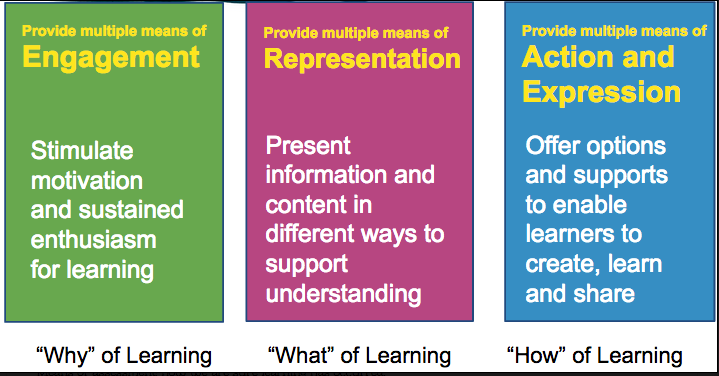
UDL is made up of three principals as shown on the diagram below.

Screen Shot 2015-08-07 at 9.20.31 AM.png


When looking at the curriculum (learning) UDL has 4 main components, each that needs to be universal.


  1. What are the goals (of the learning)?  How do we translate standards (learning intentions) into things that are important to do in the classroom.
  2. What are the materials? (books, websites, videos, posters, pictures wall displays)  Are they key to learning, if so are they universal?
  3. Methods.  How does the teacher deliver the curriculum? Lecture, collaborative groups, experiences, practical activities.
  4. Means of assessment.  How are we sure learning has occurred?


So what might this look like in your classroom?


Maths
Principal 1 - Engagement
Why do you need to learn your basic facts?
It’s important because we use maths everyday.  Shopping, measuring, driving a car, cooking.  Many jobs require you to use maths, e.g. trades, truck driver, accountants, retail, teaching and even doctors.


Principal 2 - Representation
Giving children opportunities to learn in different ways.
Instructional lessons, videos (teacher tools), using materials, digital tools, flashcards, singing table songs, rote learning.


Principal 3 - Action and Expression
What the children do to show their understanding, using equipment (counters, rods, abacus etc), number lines, tests, Explain Everything on Ipad or making a video explaining the strategy that they used.


So where does Learn, Create, Share fit?


I see that it plays an important part of the Representation stage and an even more significant role in the Action and Expression stage.


What does this mean for the learning in my class?


Creating learning activities with less barrier (no barriers in a perfect world).  Allowing agency for children to express their understanding.  It’s ok if someone wants to use Puppet Pals, while others use slide show and someone else draws a picture.


This is not rocket science, this is quality teaching and learning for all those in our classrooms.

I want to acknowledge Mark Maddren from Core Ed, for his presentation on UDL.