Translate

Showing posts with label RTC7. Show all posts

Wednesday, 21 June 2017

What is Success and Why?

2016 was a really big year for the Senior School at Hornby Primary School. Lots of new learning for teachers and students and more importantly, students and teachers getting out of their comfort zones.

So what is the 1:1 digital classrooms and the learning model of  Learn, Create share doing for our learners?   The answer, 'Bucket loads' and the best thing is that we have the data to show this!

The data from our E-asttle results shows us that we have accelerated learning and our Year 5 and 6 students are now achieving above the national norms.   Our Year 4's have also made significant gains.

But what was more pleasing and satisfying for me, was our 'Me and my School survey results that all of our year 4, 5 and 6 students completed.   The results were outstanding especially in our year 6 group.

Year 6 (n=38)
Scored higher on 27 of the 28 questions than NZ norms

The one question was 1% point lower than NZ norm

Significant responses - agree/strongly agree

  • I have a lot of respect for my teachers: 100%
  • My teachers help me learn: 100%
  • Doing well at school is very important to me: 98%
  • At school I always try to do my best: 98%
  • I feel like I am making progress at school: 95%
  • When I’m learning something that’s hard I keep on trying until I get it: 94%
  • I feel my culture is valued and respected at my school: 92%

So what's happening at our school that is causing children to accelerate their learning and also be extremely happy to attend school.    I took my time to reflect on this and have come to a couple of conclusions.  Our children are hooked.   The digital platform that we have created  caters for all students.  They are engaged but more importantly teachers are activating learning.

As teachers we are spending more time teacher and less time managing the class.  The learning is authentic and has a purpose.  The students see themselves as teachers and learners and the have a voice with a world wide audience.  This directly relates to Learn, Create, Share and the affordances of digital technologies.

So what does learning look like?  why are we making significant shift?

I created this presentation after discussions with the other teachers in the senior school team, which is essentially a reflection of our writing practice.


We had a really good reflection session at our last staff meeting run by Kate Mclachlan our literacy leader.  What got me really excited was that although we have had significant success, everyone of our staff was reflecting on what they could do to improve their practice.  We all had a clear idea of what our next steps were.

That in my books is a recipe for success.  Not being happy with status quo,  but striving to better ones practice collectively.  A great example of teacher as inquiry.


Friday, 14 August 2015

Universal Design for Learning.

UDL (Universal design for learning) What is it and how can we use this in our classroom?
Learn, Create, Share.  What is it and how can we use this in our classroom?


Can these be married together?
Do they need to be married, or can they sit nicely beside each other?


Before we look at these in more depth, we need to answer the WHY?


To raise student achievement.  Motivate and engage all learners in our classrooms especially students who are disengaged in education, have learning disabilities and have high learning needs.  
If we get it right for these children, we get it right for all children.


As educators we need to ask ourselves this one question.  How can we remove barriers and provide support that will enable all children to learn?


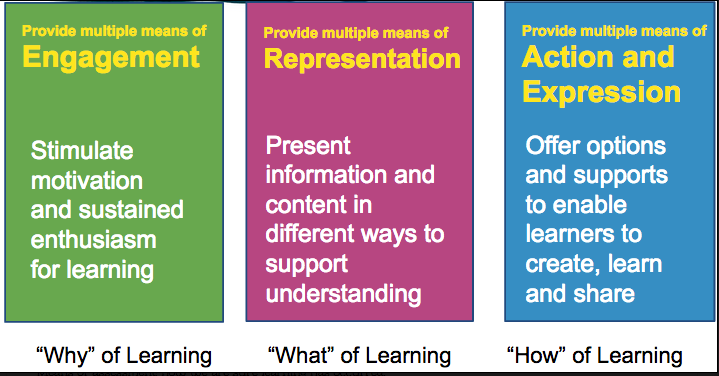
UDL is made up of three principals as shown on the diagram below.

Screen Shot 2015-08-07 at 9.20.31 AM.png


When looking at the curriculum (learning) UDL has 4 main components, each that needs to be universal.


  1. What are the goals (of the learning)?  How do we translate standards (learning intentions) into things that are important to do in the classroom.
  2. What are the materials? (books, websites, videos, posters, pictures wall displays)  Are they key to learning, if so are they universal?
  3. Methods.  How does the teacher deliver the curriculum? Lecture, collaborative groups, experiences, practical activities.
  4. Means of assessment.  How are we sure learning has occurred?


So what might this look like in your classroom?


Maths
Principal 1 - Engagement
Why do you need to learn your basic facts?
It’s important because we use maths everyday.  Shopping, measuring, driving a car, cooking.  Many jobs require you to use maths, e.g. trades, truck driver, accountants, retail, teaching and even doctors.


Principal 2 - Representation
Giving children opportunities to learn in different ways.
Instructional lessons, videos (teacher tools), using materials, digital tools, flashcards, singing table songs, rote learning.


Principal 3 - Action and Expression
What the children do to show their understanding, using equipment (counters, rods, abacus etc), number lines, tests, Explain Everything on Ipad or making a video explaining the strategy that they used.


So where does Learn, Create, Share fit?


I see that it plays an important part of the Representation stage and an even more significant role in the Action and Expression stage.


What does this mean for the learning in my class?


Creating learning activities with less barrier (no barriers in a perfect world).  Allowing agency for children to express their understanding.  It’s ok if someone wants to use Puppet Pals, while others use slide show and someone else draws a picture.


This is not rocket science, this is quality teaching and learning for all those in our classrooms.

I want to acknowledge Mark Maddren from Core Ed, for his presentation on UDL.